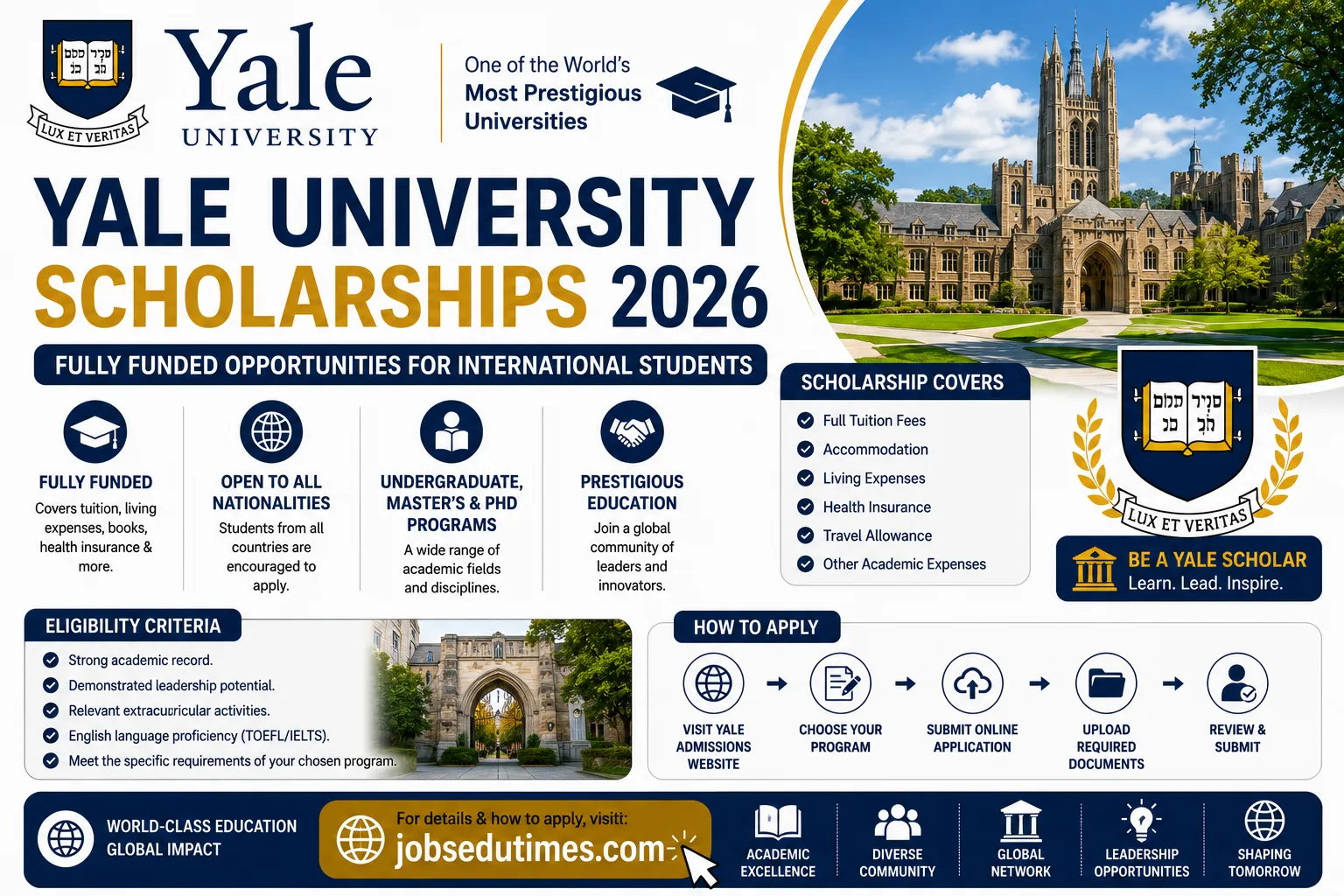
Yale University Scholarships 2026 – Fully Funded: Eligibility & How to Apply
Yale University Scholarships 2026 – Fully Funded: Eligibility & How to Apply: For many students around the world, an Ivy League education can feel financially out of reach — but Yale University has built one of the most generous financial aid systems of any university in the world, specifically to change that. Rather than offering a single “Yale Scholarship” you apply for separately, Yale operates a comprehensive, need-based financial aid program that can cover full tuition, room, and board for eligible students, alongside fully funded PhD programs for graduate researchers. Here’s a clear, practical guide to how Yale funding actually works, who qualifies, and how to apply for Yale University scholarships.
Read More: Punjab Mass Transit Authority Jobs 2026 – Latest Vacancies & How to Apply Online
First, an Important Clarification
Unlike many Yale University scholarship programs that involve a separate application form and a fixed prize amount, Yale’s financial support works differently depending on your level of study:
- Undergraduate students are considered for need-based financial aid automatically as part of the general admissions process — there’s no separate “scholarship application” to fill out.
- PhD students admitted to Yale’s Graduate School of Arts & Sciences are typically fully funded as a standard part of their offer, not something they apply for separately.
- Master’s students receive funding that varies significantly by department, since graduate funding decisions are made at the department level rather than centrally by the university.
Understanding this distinction from the start will save you time and help you focus your efforts on the right application process for your specific Yale University scholarship program.
Yale Funding at a Glance for Yale University Scholarships
| Category | Details |
|---|---|
| University | Yale University, USA (Ivy League) |
| Funding Type | Primarily need-based financial aid; full funding for most PhD programs |
| Levels Covered | Undergraduate, Master’s, PhD |
| Nationality | Open to applicants of all nationalities, including international students |
| Typical Undergraduate Coverage | Tuition, room, and board — full cost for many low- and middle-income families |
| Typical PhD Coverage | Full tuition, annual living stipend, health insurance (often for 5+ years) |
| Application Route | Common App or Coalition App (undergraduate); department-specific graduate application |
| Financial Aid Form | CSS Profile and/or Yale-specific financial aid application, alongside admissions application |
How Much Can You Actually Receive?
Yale’s financial aid is calculated individually for each family, but some general benchmarks can help you understand the scale of support available:
- Students from families earning below a certain income threshold (commonly cited around $65,000 per year) often pay nothing at all — Yale covers tuition, room, and board in full for these students.
- The average need-based scholarship at Yale is reported to be over $50,000 per year, with some awards exceeding $70,000 annually depending on family financial circumstances.
- Roughly six out of every ten undergraduate students, including many international students, receive some form of financial aid.
- PhD students in the Graduate School of Arts & Sciences are typically fully funded for at least five years, with total support often valued at several hundred thousand dollars across the full program.
- Master’s program funding varies by department, so applicants should research the specific funding policies of the department they’re applying to.
Eligibility Criteria for Yale University Scholarships 2026
While specific requirements vary by program level for Yale University Scholarships 2026, here’s what most applicants need to know:
- Academic Merit: Strong academic performance and a competitive application profile are expected across all levels, since Yale’s admissions process is highly selective.
- Financial Need: Undergraduate aid is primarily need-based, meaning your family’s financial circumstances directly determine how much support you receive.
- English Proficiency: International applicants generally need to demonstrate strong English language proficiency, often through standardized tests such as IELTS or TOEFL.
- Nationality: Yale’s financial aid programs are open to applicants of all nationalities, and international students are actively encouraged to apply.
- Valid Documentation: International students will need a valid passport and, upon admission, must complete the necessary visa documentation to study in the United States.
- Special Circumstances: Yale also considers additional support for students facing particular hardships, such as those from families receiving government assistance or students who are orphaned or experiencing homelessness.
Required Documents
To apply for admission and financial aid at Yale University Scholarships, you’ll generally need to prepare:
- Completed Common App or Coalition App (for undergraduate applicants)
- Academic transcripts and school records
- Standardized test scores, where applicable to your program
- Letters of recommendation
- Personal essay(s) as required by your application platform
- CSS Profile and/or Yale’s own financial aid application, including detailed family financial information
- Proof of income or financial documentation to support your need-based aid application
- Valid passport (for international applicants)
- English proficiency test scores, if applicable
How to Apply for Yale University Scholarships 2026: Step-by-Step
For Undergraduate Applicants:
- Choose Your Application Platform: Decide whether you’ll apply through the Common App or the Coalition App — both are accepted by Yale.
- Complete Your Admissions Application: Fill in your academic history, extracurricular activities, essays, and recommendation details.
- Apply for Financial Aid Simultaneously: Submit the CSS Profile and any Yale-specific financial aid forms alongside your admissions application, providing accurate family financial information.
- Submit Supporting Documents: Upload transcripts, test scores (if applicable), and recommendation letters by the relevant deadline.
- Wait for Your Decision: Yale will notify you by email regarding both your admission decision and your financial aid award.
- Reapply Annually: If admitted, remember that financial aid is not automatically renewed each year — you’ll need to resubmit updated financial information annually to continue receiving support.
For Graduate (PhD) Applicants:
- Identify Your Department: Research the specific graduate program and department you wish to apply to, since funding policies differ across departments.
- Apply Directly to the Program: Submit your application through the relevant graduate school portal, including transcripts, test scores, a statement of purpose, and recommendation letters.
- Funding Is Typically Automatic: For most PhD programs in the Graduate School of Arts & Sciences, full funding is included as part of your admission offer — there’s no separate scholarship application required.
- Review Your Funding Package: Once admitted, carefully review the details of your funding package, including stipend amount, health insurance coverage, and the number of funded years.
Tips for a Strong Application
- Start your preparation early, and take time to genuinely understand what makes your academic and personal background distinctive.
- Be thorough and accurate when completing financial aid forms, since incomplete or inconsistent financial information can delay your aid decision.
- For graduate applicants, research your target department’s specific funding structure and faculty research interests before applying, since fit matters as much as academic credentials.
- Don’t hesitate to apply for external scholarships and fellowships alongside Yale’s own funding — awards such as Fulbright or other independent fellowships can complement your Yale financial aid package.
Frequently Asked Questions (FAQs) About Yale University Scholarships 2026
1. Is there one single “Yale Scholarship” application I need to fill out? No. Undergraduate financial aid is considered automatically as part of your admissions application, while PhD funding is typically included in your admission offer. There isn’t a separate, standalone scholarship application at most levels.
2. Can international students receive Yale financial aid? Yes. Yale’s financial aid programs are open to applicants of all nationalities, and international students are actively encouraged to apply.
3. Is Yale really free for low-income students for Yale University Scholarships 2026? For many students from lower-income families, yes — Yale often covers full tuition, room, and board for students below a certain family income threshold.
4. Are PhD programs at Yale fully funded for Yale University Scholarships 2026? Most PhD programs within the Graduate School of Arts & Sciences are fully funded, typically covering tuition, an annual living stipend, and health insurance for at least five years.
5. Does Yale’s master’s program funding work the same way as PhD funding? No. Master’s program funding varies significantly by department and is usually awarded based on financial need and academic profile, rather than being guaranteed university-wide.
6. Do I need to reapply for financial aid every year? Yes. Financial aid at Yale is not automatically renewed — students must reapply annually with updated financial information to continue receiving support.
7. What documents are most important for the financial aid application for Yale University Scholarships? The CSS Profile (or Yale’s equivalent financial aid form) along with accurate, complete family financial documentation are central to determining your need-based aid award.
